50 greatest music films ever

Barbie as Karen in “Superstar.”

Maybe there should just be a category in the right column for “Lists.” Here’s one from the film and music writers of Time Out London (which will always be the only real Time Out) called “50 greatest music films ever except for ‘Spinal Tap’.” No, I added those last four words, but the editors explain in their intro that “we’re celebrating great films – dramas and documentaries – about real musicians.”

As if David St. Hubbins and Nigel Tufnel and Derek Smalls never actually toured in the flesh? As if they aren’t at least as “real” as, say, KISS or the Monkees or Hootie and the Blowfish, which contained no one named “Hootie” and nobody named “Blowfish.” (BTW, the Ramones weren’t really “Ramones”! Those were just stage names!) Oh, and Gus Van Sant’s “Last Days” was about a guy named “Blake.” Michael Pitt looked like Kurt Cobain, but it was only about Cobain in the sense that “Velvet Goldmine” is about Bowie or Iggy Pop or Lou Reed, or “Grace of My Heart” is about Carole King or Brian Wilson or any of the Brill Building writers (even though a lot of them wrote songs for the movie). Then there’s “‘Round Midnight” (which is on the list) with Dexter Gordon playing Dale Turner, a fictionalized version of Bud Powell…

View image Downey, CA: “What happened?” Third shot of “Superstar.” Compare to second shot of “Zodiac” — establishing a neighborhood, from a car on the street…

So, OK: No “Spinal Tap.” But no “I Am Trying to Break Your Heart: A Film About Wilco”? No “You’re Gonna Miss Me: A Film About Roky Erickson”? No “Thelonious Monk: Straight, No Chaser”? No “X: The Unheard Music”? No “The Girl Can’t Help It”? No “Wattstax”? No “Woodstock”? No “The Kids are Alright”? No “No Direction Home”? No “The Buddy Holly Story”? No “Theramin: An Electronic Odyssey”? No “Heart of Gold”? No “The Filth and the Fury”? No “We Jam Econo: The Story of the Minutemen”? No “La Bamba”? No “Kurt and Courtney”? See how much fun this is? Really, though, I’d substitute any of these for several of the selections on the list.

But, OK, many of my favorites are included: “24 Hour Party People,” “Jazz on a Summer’s Day,” “Stop Making Sense,” “DIG!,” “Art Pepper: Notes from a Jazz Survivor” (his autobiography, “Straight Life,” is the best account of addiction I’ve ever read), “The Decline of Western Civilization Parts I and II (The Metal Years)”…

View image No one here gets out alive.

At the toppermost of the poppermost: Todd Haynes’ 1987 “Superstar: The Karen Carpenter Story,” a 45-minute lo-fi “dramatization” that was never officially released because of music clearance troubles (that is, brother Richard wouldn’t let Haynes use any Carpenters tunes). Still, after 20 years as an “underground” item, it’s available from Google Video here. It’s something you really need to see: a documentary-style biopic of Karen Carpenter performed mostly by Barbie dolls. Yes, its a parody (so are most musical biopics, including others on the list — see the upcoming Jake Kasdan/Judd Apatow picture, “Walk Hard: The Dewey Cox Story” for more on that score). But it presents straightforward facts about anorexia that could have been excerpted from any PBS or 16mm educational doc of the period. It’s also a formula showbiz melodrama. But for all the layers of artifice, like Haynes’ Sirk opera “Far from Heaven,” it becomes strangely, hypnotically — and genuinely — moving. Prepare yourself for Haynes’ Dylan fantasia, “I’m Not There,” by watching “Superstar” and “Velvet Goldmine.”

ASIDE: From an interview with Haynes at The Reeler:

I actually think that it’s easier for people who know less about Dylan to go with it, if they’re up for something different. Clearly, that’s the first thing: Whether you know Dylan or not, you have to surrender to the movie to have a good time at all and get anything out of it. If you have a lot of Dylanisms in your head, it’s kind of distracting, because you’re sitting there with a whole second movie going on. You’re annotating it as you go. It’s kind of nice to sit back and let it take you. I think people get it: Even if you don’t know which are the true facts and which are the fictional things, and when we’re playing with fact and fiction, from the tone of it, you know that it’s playing around with real life. In a way, that’s what biopics always do. They just don’t tell you that they’re doing it, and they don’t make it part of the fun. You have to follow the Johnny Cash story and just sort of think, “This is what really happened.” Of course, you know it’s being dramatized, but you’re not in on the joke. You’re not in on the game of that. In this movie, at least, you get tipped off to it.Oh yeah, but about that list. Here it is. Make of it what you will:

1 “Superstar: the Karen Carpenter Story” (Todd Haynes, 1987)

2 “Don’t Look Back” (DA Pennebaker, 1967) — Bob Dylan

3 “Gimme Shelter” (David Maysles/Albert Maysles/Charlotte Zwerin, 1970) –Rolling Stones

4 “24 Hour Party People” (Michael Winterbottom, 2002) — Manchester scene

5 “Topsy-Turvy” (Mike Leigh, 1999) — Gilbert and Sullivan

6 “Monterey Pop” (DA Pennebaker, 1968) — concert

7 “Be Here to Love Me” (Margaret Brown, 2004) — Townes Van Zandt

8 “Thirty Two Short Films about Glenn Gould” (Francois Girard, 1993) — Glenn Gould

9 “Cocksucker Blues” (Robert Frank, 1972) — Rolling Stones

10 “Bird” (Clint Eastwood, 1988) — Charlie Parker

11 “The Last Waltz” (Martin Scorsese, 1978) — The Band & Friends farewell concert

12 “Rude Boy” (Jack Hazan, David Mingay, 1980) — The Clash

13 “Scott Walker: 30 Century Man” (Stephen Kijak, 2006) — Scott Walker

14 “Bound for Glory” (Hal Ashby, 1976) — Woody Guthrie

15 “The Decline of Western Civilization Parts I & II” (Penelope Spheeris, 1981, 1988) — LA punk; ’80s metal & hair bands

16 “The Devil and Daniel Johnston” (Jeff Feuerzeig, 2005) — Daniel Johnston

17 “Sweet Dreams” (Karel Reisz, 1982) — Patsy Cline

18 “Art Pepper: Notes from a Jazz Survivor” (Don McGlynn, 1982) — Art Pepper

19 “Elgar” (Ken Russell, 1962) — Edward Elgar

20 “Rust Never Sleeps” (Neil Young, 1979) — Neil Young

21 “The Future is Unwritten” (Julien Temple, 2006) — Joe Strummer

22 “DiG!” (Ondi Timoner, 2004) — Brian Jonestown Massacre, Dandy Warhols

23 “Some Kind Of Monster” (Joe Berlinger, Bruce Sinofsky, 2004) — Metallica

24 “A Hard Day’s Night” (Richard Lester, 1964) — The Beatles

25 “Jimi Hendrix” (Joe Boyd, 1973) — Jimi Hendrix(more)
December 14, 2012

Faking the real and unreeling the fake

View image Performance? Art?

Consider: If a filmmaker like, say, Brian De Palma, had used actual images of dead and injured Vietnamese war casualties in one of his fictionalized, semi-pseudo-documentary features like “Greetings” (1969) or “Hi, Mom!” (1970), would he or the films’ producers or distributors have run a significant risk of being sued by the victims or their families? Are the legal or ethical issues any different now, with the carnage in Iraq? Why or why not? A few things to mull over regarding the latest “Redacted” scandal/controversy/promotional gimmick:

I suspect that De Palma was quite consciously out for publicity at the New York Film Festival press conference for “Redacted” Monday, when he accused Mark Cuban of HDNet and/or Magnolia Pictures of “redacting” the images of actual war casualties in his film’s final montage. And it worked. Here’s a movie about documentary reporting and amateur video and blogging of the occupation of Iraq and… look! IFC has posted a viral YouTube video of the NYFF confrontation between De Palma and Magnolia Pictures president Eammon Bowles that has been featured (even embedded) on sites such as Sergio Leone and the Infield Fly Rule, Movie City Indie, GreenCine Daily, spout blog, jürgen fauth’s muckworld and I don’t know how many other outlets including… well, the site you’re looking at right now.

How much more meta do you want to get?

Bowles denies he was in on any “staging.” But De Palma? Isn’t that what he does? He provokes, he fakes, he toys with what’s genuine and what’s phony to the point where the distinctions become tricky or even meaningless. If his role in the press conference, at least, wasn’t part of a “Be Black, Baby” performance piece (see “Hi, Mom!”) then it sure ought to have been. And even if it wasn’t, it still is. Spontaneous, pre-meditated, both, neither — it’s still a spectacle designed for the cameras and the audience.

Far from Vietnam: Internet technology as used, parodied and, yes, redacted in Brian De Palma’s “Redacted.”

But that’s not really the most important issue, is it? De Palma says he got the images for the montage sequence either off the Internet or otherwise, and that they are photos of real people, with real injuries, that photographers took in Iraq. Except for a couple pictures created specifically for “Redacted” — an wounded pregnant woman featured earlier in the movie and the victim of the fictionalized, (re-)enacted rape and murder — the photos are meant to be perceived as shockingly unfiltered, and/or to further the movie’s strategy of pushing the viewer to question what is real (I suppose I really should put quotation marks around that word in this context) and what has been composed for the movie you’re watching. In the version of “Redacted” shown at the Toronto and New York Film Festivals, and perhaps in Venice and elsewhere, the faces of the actual victims have been blacked out — as if someone had taken a marker and scribbled over their eyes to conceal their identities. (The logo of a YouTube-lookalike site shown in the movie has been similarly “redacted.”)

De Palma says he wants to use the montage with the unredacted faces. Bowles says (in comments posted at Movie City Indie):

the sole reason that the photos are redacted, is that it is legally indefensible to use someone’s unauthorized photo in a commercial work. any claim to the contrary is either hopelessly naive or willfully false. And any indemnification does not preclude getting sued, and considering the asset bases of cuban and wagner versus depalma, there’s no issue about who’s purses will be attacked (not to mention the presumption of agreeing to the image of one of your loved one’s mutilated body living on in the world wide media). Brian De Palma is neither naive nor stupid. He knows what Bowles says is true — and that even if a suit went to court and the producers were able to successfully argue that their use of the photos was journalistic in intent, even within the context of a non-documentary commercial feature film, the cost of fighting such a lawsuit would be significant. In fact, “Redacted” announces itself as a “visual document” of “imagined events” (I’m not sure I remember the exact language used in the opening titles, but I believe that’s close), and as such does not attempt to present any factual documentation for those events. De Palma also knows that, while “Redacted” plays with documentary, web, home video and other techniques and formats, it can’t help but be an exploitation movie too, no matter how serious its concerns. It’s right there in the title: Come see what has been forbidden for you to see.

Again, that’s what De Palma does….

December 14, 2012

Letter: When theories become fact

From Joe Killin, Lakeland, FL:

I am a nineteen year old college student in Lakeland, Florida, I am a self-proclaimed thinker, and more often than not, I am a fool. I was originally homeschooled as a child by — of course — my mother. I have been brought up as a Christian (a term I hate, by the way), I’ve been educated with Christian cirriculum, but only recently did I decide that I wanted to be a Christian.

I’m sure you have received a multitude of letters on this topic already, but I hope mine stands out because I want to point out some things that I have not seen anyone else point out — namely, things about our culture’s way of educating people.

December 14, 2012

Reminder: Contrarianism Blog-a-Thon next week!

View image It’s a jolly horrorshow with Mary.

Just a reminder that I’m hosting the Contrarianism Blog-a-Thon next weekend, Feb. 16 -18. Got some contrarian thoughts you’d like to share? A film theory that goes against the grain? A despised movie that, upon reevaluation, deserves respect and admiration? A “masterpiece” that only you recognize as disingenuous hack work that is bad for children and other living things? We’re here to listen, and to learn. Please let us know about it. Send me your links at the e-mail address above when the time comes…

Meanwhile, in anticipation of the Contrarianism Blog-a-Thon, Dennis Cozzalio at Sergio Leone and the Infield Fly Rule has posted a, um, “depreciation” of Julie Andrews’ Mary Poppins. Just a spoonful of castor oil to help the sugar go down…

December 14, 2012

‘Saturday Night Live’ Lives – Still Loved, Much Needed

It’s with pleasure and excitement that I welcome Tom Shales, a good friend, as a blogger on this site. Tom, the nation’s best-known television critic, won the Pulitzer Prize while writing for The Washington Post from 1972 to 2010. His blog will focus on TV and whatever else he feels moved to write about. — RE

Apparently a new bylaw at “Saturday Night Live,” which began its 38th season this weekend, is “The worse the host, the more sketches in which he’ll appear.” So it was with big let-down Seth MacFarlane, multimillionaire comedy tycoon who hosted the season premiere. Once he arrived on the show’s tiny (and, yes, “iconic”) stage, he was punishingly omnipresent for the whole 90 minutes.

We can be grateful he didn’t grab a cow bell and crash the musical act.

With the exception of MacFarlane – a man who has gone farther with less than perhaps even Tyler Perry — the series seemed to be in tip-top ship-shape shape, especially considering that it begins a new year minus two of its greatest cast assets: Andy Samberg, off to make more movies, and the incomparably versatile Kristen Wiig, the funniest woman in television since Tina Fey. Or maybe since Gilda Radner. Or maybe since Carol Burnett. Or maybe since, dare we say it, Lucille Ball?

December 14, 2012

“We can’t stop the dancing chicken!”: Ebertfest photos #2

View image David Bordwell (who needs no introduction to readers of Scanners), Michael Barker of Sony Pictures Classics, and Werner Herzog discuss Herzog’s “Stroszek.”

“Stupidity is the devil. Look in the eye of a chicken and you’ll know. It’s the most horrifying, cannibalistic, and nightmarish creature in this world.”

— Werner Herzog

I could listen to Werner Herzog talk all night. And I have. (See this transcript from Ebertfest 2005, for example.) Watching the marvelous “Stroszek” (I think of it as Herzog’s Fassbinder movie), with Werner, as everyone calls him, seated in the audience two rows behind me, the famous dancing chicken at the end reminded of the quote above. (“Stroszek” has one of the great final lines in movies: “We have a 10-80 out here, a truck on fire, we have a man on the lift. We are unable to find the switch to turn the lift off and we can’t stop the dancing chicken. Send an electrician. We’re standing by…” Those of us who are not waiting for Godot are indeed waiting for the electrician, or someone like him…)

View image The vibe you get from this picture perfectly captures what Ebertfest feels like. Here, David Bordwell shows off his midnight-hour chocolate-banana shake at the Steak ‘n Shake (yes, there’s only one apostrophe in that). Somehow, when he began drinking it, he got the banana and the chocolate to stay separate on either side of the plastic straw, too. These are the things that make life worth living. (You see, the chocolate represents the movies and the banana represents the people and Roger is the glass and Chaz is the whipped cream and cherry on top and…)

Later I asked Herzog if he had changed his mind about chickens, dancing or otherwise. “I only like eating them,” he said. In response, I naturally quoted a great exchange from “Chinatown”:

Noah Cross (John Huston), peering at a fish on J.J. Gittes’s plate: I hope you don’t mind. I believe they should be served with the head.

J..J. Gittes (Jack Nicholson): As long as you don’t serve the chicken that way.

View image Writer Anna Thomas (“El Norte”) interviews Prof. Samba Gadjigo (director of “The Making of Moolade”), actress Fatoumata Coulibaly, and actress/activist Marcia McBroom-Small (“Beyond the Valley of the Dolls”) for “Moolade.”

I also asked Herzog if he’d seen Michael Winterbottom’s fantastic bio-comedy about the Manchester music scene, “24 Hour Party People” (perhaps second only to “The Three Burials of Melquiades Estrada” among my favorite films of the new millennium — and the one I’ve enjoyed re-watching the most), in which the lead singer of Joy Division commits suicide with the last scene of “Stroszek” playing on television in the background. Herzog said he’d heard about it, but hadn’t seen the movie. Well, he has something to look forward to.

View image Filmmaker Eric Byler (“charlotte sometimes”) and actor Scott Wilson (“Come Early Morning”) — both Eberfest vets.

If you’d like to listen to part of the discussion between Herzog, David Bordwell and Michael Barker (a low-fi MP3 recording made on my Treo 680 — have I mentioned how much I love my Treo 680, the life-changing “TiVo” of handheld gadgets?), click here.

It was remarkable to see how the Angry Young Herzog I remember from the ’70s and ’80s (in Seattle and especially Telluride) has evolved into such a congenial elder statesman. As his friend Paul Cox (who cast Herzog to play the father in “Man of Flowers,” a film he described as being about “male loneliness”) lamented technology (Cox is irrationally terrified of computers and cell phones), and proclaimed the imminent end of mankind’s time on Earth, Herzog was more genial and philosophical. Yes, he said, it may be our turn to become extinct, like many species before us, but that’s no reason to be “gloomy” in the time we have left: “Let’s keep making films and treasuring friendships and drinking beers.”

(When Cox, who spoke of women almost as if they were another species — claiming they were “closer to the soil” in a way that made them sound almost bovine — said that he couldn’t think of any films about “female loneliness,” Kristin Thompson came up with three masterpieces off the top of her head: Krzysztof Kieslowski’s “Three Colors: Blue,” Chantal Akerman’s “Jeanne Dielman,” and Carl Theodor Dreyer’s “Gertrud.”)

OK, now a few more pictures from Ebertfest 2007, after the jump…

December 14, 2012

The Hitchens/God challenge & The Atheist Film Fest

Jesus W. Bush.

Forget Christopher Hitchens on Iraq. The author of the “controversial” “God Is Not Great: How Religion Poisons Everything” (9 weeks on the New York Times best-seller list, now at number 2 — but only among people who buy and read books) has misplaced his delusional faith in the Rumsfeld / Cheney / Bush version of Mess ‘o Potamia for too long. When he writes or speaks about the invasion and occupation of Iraq, he is as unintelligible as someone speaking in tongues. Which, essentially, he is.

But when it comes to god, Hitchens is not similarly faith-based. To decide not to profess faith in a personal god in America these days — when even militant Islamists acknowledge Muslims, Christians and Jews as “people of the book,” fellow believers in Abrahamic religion — is one of the few remaining Politically Correct taboos. Theistic concepts of god are everywhere: on our money, in our Pledge of Allegience, in White House pronouncements from our Televangelist-in-Chief… There are no self-identified atheists (“non-theists”) in Congress [correction: one, as of 2007: Rep. Pete Stark], and some state laws prohibit nonbelievers from running for public office — the “no religious test” provision of the constitution notwithstanding.

So, it’s rather surprising for a change to find a small breath of fresh air emanating from Hitchens, who is better known for his stale, flammable whiskey-drenched halitosis. Some of his anti-religious arguments are as irrational as his Rumsfeldian ones (and the religious beliefs he savages), but at least his atheistic provocations lack the overwhelming sense of self-justification that overburdens his ex post facto rationalizations about Iraq.

Responding to a Washington Post piece by Michael Gerson (What Athiests Can’t Answer”), Hitchens poses a challenge:

Here is my challenge. Let Gerson name one ethical statement made, or one ethical action performed, by a believer that could not have been uttered or done by a nonbeliever. And here is my second challenge. Can any reader of this column think of a wicked statement made, or an evil action performed, precisely because of religious faith? The second question is easy to answer, is it not? The first — I have been asking it for some time — awaits a convincing reply. By what right, then, do the faithful assume this irritating mantle of righteousness? They have as much to apologize for as to explain.

Essentially conceding that philosophy and secularism do not condemn their adherents to lives of unbridled selfishness, and that (say) the Jewish people did not get all the way to Mount Sinai under the impression that murder and theft and perjury were okay, and also that we could not have evolved unless human solidarity was in some way innate, Gerson ends weakly by posing what is a rather moving problem.

“In a world without God,” he writes, “this desire for love and purpose is a cruel joke of nature — imprinted by evolution but designed for disappointment.” Again, he substitutes the wish for the thought. We very probably are, as he admits, not the designed objects of the Big Bang or of the process of natural selection. But this sober conclusion, objective as it is, is surely preferable to the delusion that we have been created diseased, by a capricious despot, and then abruptly commanded to be whole and well, on pain of terror and torture. That sick joke is one that we can cease to find impressive, that belongs in the infancy of our species, and gives a false picture of reality that we would do well to outgrow.

Which got me thinking: I can think of many, many religious movies (from silents like “Ben-Hur,” through the biblical epics of the 1950s, the Christian parables of Ingmar Bergman, up to “The Passion of the Christ” and “Dogma”). But can you think of some movies that are explicitly atheistic, that argue against belief not just in religious dogma but in theism itself? Even “Monty Python’s Life of Brian,” though a satire of religious history and religious thinking, specifically confirms (in a tongue-in-cheek way) the New Testament version of the birth of Jesus in the opening scene, when the three wise men withdraw their gift-balms from Brian’s manger and re-gift them to a child in glowing swaddling clothes nearby….

If you were programming an Atheist Film Festival, what titles would you include? I’m drawing a blank at this moment.

December 14, 2012

Dr. Haneke’s diagnosis

Michael Haneke, Austrian experimenteur.

UPDATED (03/15/08)

Selected interviews: From Adam Nayman’s interview/review with “Funny Games” director Michael Haneke in Toronto’s eyeweekly:

“I’m trying to impart in my films what mainstream movies work to take away,” explains Haneke in an exclusive interview. “Namely: reality. I’m making movies that are inconsumable. And I can only do that by portraying the suffering of the victim, rather than the enjoyment of the perpetrator.” […]

Haneke says that he had always conceived “Funny Games” as an assault on American films, and that the remake merely serves to place the action in its correct context. (It also creates severe cognitive dissonance; my eyes kept scanning the impeccable, palpably Euro-art-house compositions for subtitles.) Over the past decade, American genre flicks have only grown more sadistic.

“This makes my film even more up-to-date than it was before,” laughs Haneke. So what about the trailers, which make the film look like the very dreck it means to critique?

“If that kind of marketing brings in the audience that I want to reach, then that’s fine,” says Haneke. “The bigger the audience, the better… every filmmaker feels that way. The difference [between myself and other filmmakers] is that I am not willing to make any concessions within the films themselves.”

December 14, 2012

The Elements of Style

“Even to a writer who is being intentionally obscure or wild of tongue we can say, ‘Be obscure clearly! Be wild of tongue in a way we can understand!'”

— Strunk & White, “The Elements of Style” (musical adaptation by Nico Muhly)

I love it when artists known for their work in one medium show a passionate investment in another. Over the weekend I stumbled upon composer Nico Muhly’s blog. This is the guy who studied with John Corigliano and Christopher Rouse, made two albums of his own music (Speaks Volumes and Mothertongue), and has collaborated with Philip Glass, Björk, Antony and the Johnsons, Bonnie “Prince” Billy (aka Will Oldham, of “Old Joy” and “Wendy and Lucy”) and Grizzly Bear, among others. And he’s the composer of the scores for “Choking Man,” “Joshua” and “The Reader.” (The middle one is actually a pretty good movie.)

December 14, 2012

What we talk about when we talk about film criticism

Matt Zoller Seitz’s “The House Next Door.”

I feel strongly that film, and film criticism, are two sides of the same coin, each essential to the experience of the other. Without both sides, the coin itself couldn’t exist in three-dimensional space (and certainly wouldn’t be worth anything!). If movies are just forgettable eye exercises, patterns of light and shadow and sound that have no artistic or psychological or cultural significance, then what is there to analyze or criticize? And if the unexamined life is not worth living, then I don’t see how the unexamined film is worth watching.

Last Saturday, I was supposed to have been on a panel called “Why Film Critics Matter” at the Port Townsend Film Festival in Washington State, organized by Kathleen Murphy. And I would have been, if it hadn’t been for a scheduling misunderstanding. As it turns out, I was still in Toronto. But I sent Kathleen some thoughts to share on the panel, and I’d like to share ’em with you, too. This e-mail was composed after a lunchtime conversation with one of my favorite movie bloggers, Girish Shambu, and what we talked about was still reverberating in my head, so I want to thank him for his substantial contributions to this train of thought:

* * *

It’s Friday, I’m still at the Toronto Film Festival which winds up this weekend, and I just got back from lunch with Girish Shambu, a movie blogger based in Buffalo, NY. I’d never met Girish before — I’ve known him only through his blog, and the community of bloggers who contribute to critical discussions of movies on one another’s sites (including my Scanners blog) — and I’ve never been more excited about the future of film criticism than I am at this moment.

First, let me explain what I mean by “film criticism.” In traditional, mainstream print media (mostly newspapers and magazines), it is usually thought of as reviewing. Newspapers run their critics’ reviews of movies that are entering theatrical release in their local market. This is the most common, and narrowest, definition of what “film criticism” can be — part consumer guide (a recommendation on a binary or sliding scale from positive to negative), part reportage (what the story’s about, who’s in it, who directed it), and, if you’re lucky, part film appreciation (how the movie functions as an assemblage of images and sounds).

December 14, 2012

Avatar, the French New Wave and themorality of deep-focus (in 3-D)

In 1959 Jean-Luc Godard famously proclaimed that tracking shots are a matter of morality — an inversion of fellow Cahier du cinéma critic Luc Moullet’s formulation that “morality is a matter of tracking shots” (“morale set affaire de travellings,” sometimes translated as “morality is in the tracking shots”). The evangelical theorists behind what became known as the French New Wave had a tendency to ascribe moral values to cinematic style and technique.¹ André Bazin and the late Eric Rohmer, especially, championed the moral as well as aesthetic superiority of mise en scène over montage, of Hawksian “invisible cutting” over dictatorial Eisensteinian editing, and of deep-focus over a more selective, shallow depth-of-field. Bazin praised directors such as Orson Welles and William Wyler (in collaboration with cinematographer Gregg Toland) for staging shots so that “the viewer is at least given the opportunity to edit the scene himself, to select the aspects of it to which he will attend.”

As David Bordwell summarized:

Their “deep-focus” style, he claimed, produced a more profound realism than had been seen before because they respected the integrity of physical space and time. According to Bazin, traditional cutting breaks the world into bits, a series of close-ups and long shots. But Welles and Wyler give us the world as a seamless whole. The scene unfolds in all its actual duration and depth. Moreover, their style captured the way we see the world; given deep compositions, we must choose what to look at, foreground or background, just as we must choose in reality. […]

[Bazin wrote that deep-focus] “forces the spectator to participate in the meaning of the film by distinguishing the implicit relations” and creates “a psychological realism which brings the spectator back to the real conditions of perception.”

December 14, 2012

For the Love of Film Blogathon: Feb. 14-21

The For the Love of Film Blogathon (co-hosted by Ferdy on Films and Self-Styled Siren to benefit the National Film Preservation Foundation) has already inspired Greg Ferrara at Cinema Styles to come up with these two groovy announcements. I hope I can think up something worthy of contribution — but meanwhile I’m certainly going to be soaking up all the terrific stuff that’s come flooding in…

P.S. Anybody remember when the Scherzo from Beethoven’s Ninth (used in the montage above) served as the theme for NBC’s nightly newscast, the “Huntley-Brinkley Report” with Chet Huntley and David Brinkley? Arturo Toscanini conducting the NBC Orchestra, of course. “Good night, Chet. Good night, David. And good night for NBC News.”

December 14, 2012

Kubrick and the cosmic zoom

 A mighty zoom. It begins here…

… and ends here.

It’s been said that what “The Shining” is to the dolly/Steadicam shot, “Barry Lyndon” is to the zoom. Jeffrey Bernstein offers an in-depth exploration of all those slow, still-life zooms in “Barry Lyndon” — 36 of them by his count, and I believe him! (Here’s the .pdf file.) I have so much reading to do.

The zoom, because it is purely optical and does not involve actually moving the camera, has unique visual properties. It tends to flatten the image as it enlarges it (I was going to say “gets closer,” but of course that’s the point — it doesn’t). Kubrick uses it so that his characters appear to be locked within the frame, and shots are presented like paintings — portraits or landscapes. It’s part of the canvas of the film, as it were. (BTW, my revised 1981 appreciation of “Barry Lyndon,” one of my favorite films, can be found here: “Barry Lyndon and the Cosmic Wager.”)

Bernstein writes:

In “Barry Lyndon” Kubrick elevates a ‘poor cousin’ as it were of film technique—the zoom in progress—to a central position. In the first twenty-one minutes of the film there are six zooms and one zoom-like track-out. The majority of these zooms are elaborate; the shortest in duration lasts no less than ten seconds, while the fifth (the Nora-Captain Quin love scene) lasts a remarkable thirty-four seconds, and the sixth (the opening of the Barry-Captain Quin duel) lasts thirty seconds. Six of the first eleven scenes in the film, including three scenes in a row, begin with elaborate zoom-outs. The audience can’t help but notice the zooms. Perhaps never before in the history of commercial cinema have zooms been employed to be noticed by the audience. And not only to be noticed, but to be thought about as well. It seems to me that Kubrick’s use of the zoom movement in “Barry Lyndon” is the most elaborate and sustained use of zoom movement ever seen in a film.You’ll get no argument from me! Though Robert Altman and Vilmos Zsigmond do deserve special mention for their work in “McCabe and Mrs. Miller,” “Images” and “The Long Goodbye.” In the latter the camera never stops zooming and moving, as if it were bobbing on the waves at Malibu…

(Yes, those last four words are a Joni Mitchell reference.)

December 14, 2012

High camp: Does it translate?

Hissy fit over the South Pacific.

Carlos from Venezuela raises some intriguing questions in his comments about “Snakes on a Plane” below. Some excerpts from what he wrote:

This leads me to the big question, how in hell is … New Line Cinema planning to market the movie in territories where the concept of “so bad that is good” is not as widespread as in some other countries, like the US or the UK?

To me the newspaper ads printed in Venezuelan newspapers … seemed like they were for any of the usual Straight to DVD (pirated or not) movies that open commonly in my country in mainstream Cinemas (like Van Damme flicks, forgettable sequels of classic Disney films and the like)….

They (the printed ads) were trying to appeal the horror factor of the movie/concept, without any indication of the non-existent local hype about the movie, that for most Venezuelans stars the “guy from Blade/XXX: State of the Union/Lethal Weapon/Training Day/Boat Trip/Pulp Fiction” I stress this not because Im trying to make a cheap unPC remark. It is because for most of the audiences in Venezuela, there’s no extra “OH the B*das* Motha*c*a Sam Jackson is saying mothaf*c*ing snakes” factor, its basically any familiar African Amercian actor saying subtitled profanites and I have the feeling that it might not be THAT different in Thailand or Ecuador, but I could be wrong.

So what you have left is a plain bad planned plane movie. The movie is totally stripped off its toungue in cheek (aspired) value, and I dont think that we’re going to get the explanaiton of its campy factor from Hugo Chávez’ Sunday tv show either.

BTW: Im planning to see it. And I will see it in the one cinema closest to the Caraca’s downtown, where I could be almost certain that no one would be polluted by the E! Latinamerica globalized hype machine.

For perspective, it may help to remember that among films not originally released as “spoofs” in the United Sates are: “Mommie Dearest,” “Showgirls,” “Red Dawn,” “Rambo: First Blood Part 2,” “The Jazz Singer” (Neil Diamond/Laurence Olivier version), “Mystic River” and “Crash” (2005). All of these movies were instantly considered camp classics by a significant minority, even if they weren’t received that way by mainstream audiences when they first appeared in theaters.

December 14, 2012

Early returns: The ascent of the Stephanopoulos

Polls may be open somewhere, results in many races remain inconclusive, but I am willing to make one fearless projection: ABC News is the winner in 2012’s Election Night coverage. In fact, ABC’s coverage of the entire campaign has generally left competitors red in the face if not green with envy, though that hardly means it was without its own fumbles, stumbles and wretched excesses. 

December 14, 2012

Face/Off: Avatar

There’s a little back-and-forth between me and Glenn Kenny about this Oscar-nominated picture called “Avatar” over at MSN Movies. Good heavens, I wonder, what’s all this fuss about? Maybe you’re just a fogey, Glenn suggests. I say I wanted to visit a world of awesome mystery and wonder, and all I got was this velvet painting of a movie. Glenn says that he wanted a state-of-the-art “ass-kicking James Cameron science fiction action movie” — and, for him, “Avatar” delivered on that score.

December 14, 2012

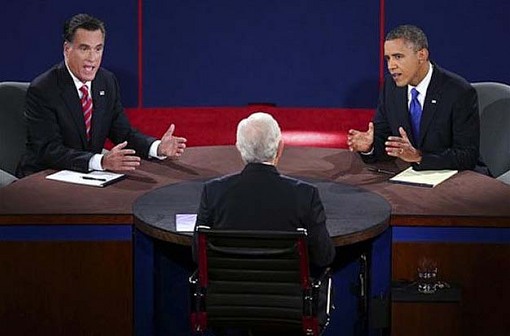
The final debate: Whoppers and bayonets

(AP photo)

It was almost as if President Obama’s advisors had said before the debate, “Don’t agree with Romney on anything,” while Romney’s advisors might have said to their boy, “Agree with Obama as much as possible.” After all, this third and final presidential debate of 2012 was supposed to be about foreign policy, an area in which Obama is expert and seasoned and in which former governor Romney has no enviable credentials.

December 14, 2012

TIFF 2007: Movie bloggers EXPOSED!

View image Me with post-festival headcold, after just getting back home and sinking into the comfort of my den-like Man Chair. (all photos by Jim Emerson, except as noted)

My taxi driver to the airport yesterday (he was Ethiopian, but had lived in Toronto for 18 years) asked me if I’d seen any “movie stars” at the film festival. I had to admit I hadn’t — although I’ve encountered people I consider to be movie stars on the street in past years: Luis Guzman, Liev Schreiber, Brian De Palma, Sara Polley, Stephen Rea, Jean-Pierre and Luc Dardenne…

View image

The ubiquitous (and deservedly so) Girish. A man with cinecurean tastes. (That’s a neologism of my own invention that is related to “epicure” and has nothing to do with “sinecure,” I don’t think.)

Toronto, at least at festival time, is a celebrity-mad city like no place I’ve ever seen. Celebrities make the front pages of the newspapers just because they’re celebrities and they’re in Toronto. Rogers cable used to have a non-stop TIFF schedule of celebrity gossip, celebrity interviews, off-the-cuff “reviews,” and celebrity press conferences. I don’t know if they did that this year, because I never turned on the television in my hotel room. (Meanwhile, TiVo was covering other necessities for me at home.)

View image Andy Horbal plays Mephisto at the foot of the Stairway to Heaven (the escalator to the Varsity Cinemas).

View image The House Next Door’s Keith Uhlich took this shot of himself with his MacBook, outside the press office at the Delta Chelsea.

Some journalists and critics were doing celebrity interviews in addition to going to movies, with stars like George A. Romero (whose girlfriend was the bartender at my hotel!) or Jodie Foster or Brian De Palma or Bela Tarr — in gang-bang roundtables or 15-30-minute individual sessions. The people I was most excited about getting to meet were my fellow movie bloggers. I had lunch with Girish Shambu between screenings in Toronto last year, and it was a pleasure to see him again, particularly since he enjoyed the oblique, androgynous eroticism of the luminous Eric Rohmer movie as much as I did. His highest recommendation was for Barcelona-born director Jose Luis Guerin’s “Dans la ville de Sylvia” — which, unfortunately, I missed. We also thought Lee Chang-dong’s “Secret Sunshine” was among the very best things we’d seen.

View image Frames within frames within frames — and film-festival bedhead. Me at work in my Toronto hotel room.

Keith Uhlich, editor of “The House Next Door,” organized a mid-fest critics’ roundtable podcast, ’round a tiny round table in Nathan Lee’s hotel room with Nathan (whose byline should be familiar from the Village Voice, Film Comment, The New York Times), Torontonian eyeWeekly critic Adam Nayman, Keith, and me. It was too much fun — we ran out of time long before we ran out of stuff we wanted to talk about. Of course, that was the morning I forgot to bring my camera. Too bad, because if you saw Nathan’s new-mown haircut, you’d want to rub his head. It’s that cool. (I’ll post a link to the podcast when it’s available, if you want to hear us go on about the trials of film critics filing reports and interviews from festivals, our indelible images from TIFF, Brian De Palma, Bob Dylan, Todd Haynes, semiotics [not much!], and I forget what else.)

View image Christopher Long, in Philly Eagles t-shirt, who has a woman on his right shoulder saying: “Come, have another cup of coffee!” and a man on his other shoulder saying: “No, there’s a huge schedule of films to see — what’s next?”

I also got to meet up with Christopher Long, a frequent and valued contributor to Scanners comments, and reviewer for DVDTown and other sites. Chris claims to loathe Paul Haggis’s “Crash” (and Sam Mendes’s “American Beauty” — two peas in a pod) even more than me. I don’t know if that’s possible, but I found him convincing. They both do the same morally corrupt thing, anyway: taking grotesque clichés and then flipping them around so that that they are… even more insulting clichés. All in the name of “enlightenment.” We had a nice talk about our mutual admiration for Divine, too. Don’t recall how that one came up.

I’m delighted to have more faces to put with the words I’ve appreciated from these folks for so long.

December 14, 2012

To spoil or not to spoil? (Don’t worry.)

The guy in the black suit is really the millionaire playboy Bruce Wayne who became a caped crusader after his parents were killed. And he’s played by Christian Bale, just like in the previous movie, “Batman Begins.” Ooops. Is that giving too much away?

Note: There are no “Dark Knight” spoilers in this post. None whatsoever.

There, I said it. Really, what’s so difficult about adding a spoiler warning to a review? Ken Tucker, “critic at large” for Entertainment Weekly, is just indignant about the whole idea:

Whether I’m writing a review or reading one, I don’t want any held-back information to prevent that review from being the most interesting, thought-provoking one possible.

If that means a movie critic reveals a crucial plot point in order to lay out an argument for a film’s greatness or its hideousness, so be it.

OK, remember we’re talking about a deadline-driven review here — something relatively brief (usually more than seven words and considerably less than 1,000 words in EW) shortly before or after a movie or TV show first becomes publicly available in one or more US cities. Not a longer critical essay targeted at a reader who has already seen the work in question. (See David Bordwell’s recent piece about the differences here.)

I feel there are two kinds of ideal readers for release-date-dependent reviews:

December 14, 2012

“That’s funny…That plane’s dustin’ crops where there ain’t no crops.”

Alfred Hitchcock’s “North By Northwest” is just about my favorite movie. No film has ever been more entertaining. (See Glenn Kenny’s personal paen to the picture, “Obviously, they’ve mistaken me for a much shorter man.”) And a piece of it is still alive and well in Lake Forest, IL. From The Lake Forester:

“I bought it about five years ago,” Knauz, 81, said of the fully restored Navy N3N that he keeps in his hangar at the Kenosha Regional Airport.

The appeal of owning the plane used in the film — named by the American Film Institute as the 7th greatest American mystery movie in history — intrigued Knauz.

“It sat in a hangar in Bakersfield, California until I found it,” Knauz said during an interview at his hangar, “Stick and Rudder,” in Kenosha.

“The guy I bought it from actually restored it in Hawaii,” Knauz said, explaining that the surplus Naval planes built before World War II were later converted to crop-dusters.

(photo by Michelle LaVigne)

December 14, 2012
subscribe icon

The best movie reviews, in your inbox