

Archives

Food. Films. China. World.
I’m sitting on a plane that is about to take off for Hong Kong. Looking out on the tarmac at Beijing, I can’t quite believe my first two weeks here are already over, and Hong Kong International Film Festival is just around the corner.
The past week has been a whirlwind of food, work and discovery, not always in that particular order, but always an interesting combination of sorts.
Let’s start with my favorite indulgence while traveling: Food. Fresh food, persevered food, homemade food, street vendors food, gourmet food… you name it, I love it. Gastronomic adventure is, in my opinion, one of the greatest pleasures in life, and I’ve never shied away from its waters. I don’t just dip my toes, I jump in headfirst and splash around like a five year old.
Four screenings, from blues to bliss

Walking down a narrow side street from my hotel to the Palais at 7:55 am every morning involves running a gauntlet of persistent petitioners, who appeal to those rushing to the 8:30 am press screenings for spare admission tickets. Press get in by showing their badges, but those whose accreditation is only through the film market sign up online for tickets, which they sometimes don’t need. Spare tickets must float around frequently enough to justify cinephiles of all ages honing their approach techniques, from aggressive and confrontational to polite and needy. Some hold little handmade signs with the name of the day’s film, and close in no matter how fast you walk or how diligently you avoid eye contact.
Left: Im Sang-soo’s remake of “The Housemaid.”
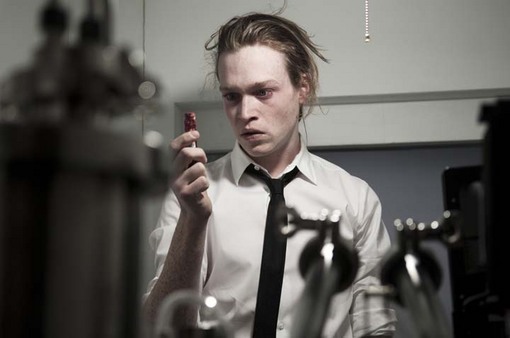
Viruses biological and psychological
The sounds of Cannes usually begin for me before daylight, when I’m awakened around 5:00 am by the noise of the big motorized awning of the bistro that’s directly under my window being rolled down for the day. That’s quickly followed by the watery roaring of the street-cleaning machine as it drives up and down the little plaza where the bistro sets up its outdoor tables and chairs. Then, comes the metallic scrape of dozens of chairs being dragged into place. Finally, some natural sounds: birds, including the big screeching gulls that fly inland from the waterfront a few blocks away. The alarm goes off and it’s time to start another festival day by arriving at the Palais at 8:00 am to get a seat for the 8:30 am press screening.
“Lawless” by John Hillcoat, the first of four American films in the year’s competition, premiered this morning. Set in Franklin, Virginia, in 1931, this is a Prohibition-era tale of a real family, the Bonderants, who became local legends as notorious moonshiners. Legend is the operative word here, as this is a highly romanticized story of three macho brothers and their apparent talent for besting the law, the competition, or death, as the case may be. This is film in which the good guys can be beaten to a pulp and be OK the next day, or take a shotgun blast to the gut from fore to aft but still get up and walk.
The cast is easy on the eyes: Tom Hardy as the eldest brother Forrest, who, as reputation has it, cannot be killed; Jason Clarke as Howard, the fearless middle brother who’s batshit crazy when he’s been consuming the product; and Shia Lebeouf as the youngest brother Jack, an aspiring lady’s man who still has a lot to learn about the family business. Love interests include Jessica Chastain as a former fan-dancer from Chicago who shows up at the Bonderant enclave seeking the quiet life (!), and Mia Wasikowska as the sheltered daughter of a fundamentalist preacher.
Love under stormy skies
Sunday dawned with a dark and threatening sky and a chill in the air, continuing the dreary weather trend of the past two days. It’s a day of heavy-hitters here at Cannes, with two greatly anticipated films by major directors premiering in competition: “Amour” (“Love”) by Austrian Michael Haneke in the morning; and “Like Someone in Love” by Iranian Abbas Kiarostami in the evening. Is the weather an omen or just weather? We’ll see.
Neither of today’s competition films was made in the director’s home country. Haneke made “Amour” in France with French stars, but then he has more frequently worked in France in recent years. Kiarostami made his previous feature “Certified Copy” in Italy with an international cast, but “Like Someone in Love” was made in Japan with a French producer, a first for the globe-trotting director.
Michael Haneke has made his reputation on a uniquely transgressive form of cinema. Films, including “The White Ribbon,” “The Piano Teacher,” and “Funny Games,” cross boundaries and break taboos, all the while drawing the audience into complicity with moral compromises and sometimes vile acts. “Amour” represents a new and more gentle and affecting take on that artistic strategy.
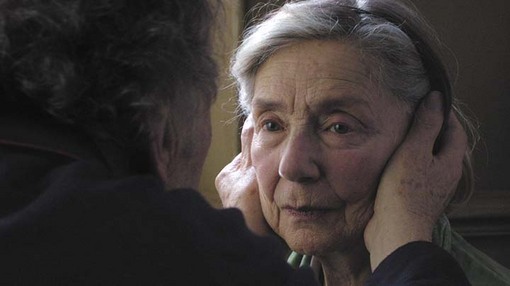
In “Amour,” veteran French stars Jean-Louis Trintignant (“A Man and a Woman,” “My Night with Maud”) and Emmanuelle Riva (“Hiroshima Mon Amour”) play Georges and Anne, a married couple in their 80s. They are retired music teachers who live in a lovely high-ceilinged apartment, and their comfortable lives are steeped in music and the arts. Their adult daughter Eva (Isabelle Huppert), also a musician, has a busy life of touring with her British husband.
“Cannes, içi, Cannes”
May 12th — I have arrived. Perhaps it is just because I am writing about my experiences in Cannes this year or perhaps it is just bad luck, but there were many points during these past four days where I thought would not make it here before the festival began. On Saturday afternoon, my sister was running around the house doing some last minute packing and I was reading a fellow Cannes blogger’s post about Eyjafjallajokull — the not-so-friendly, Icelandic volcano. When I realized the volcano was causing travel problems again, I quickly looked up our flight and the status was a big, red “canceled.” It was at this point that my emotions erupted right along with the volcano.
Left: My sister, Lily, holds up her sign and makes friendly eye contact with passersby in the hopes of receiving a ticket to the premiere of “Robin Hood.”
Hong Kong FILMART, Jia ZhangKe, and Star Ferry
• Grace Wang of Toronto Running concurrently with the Hong Kong Internatiomal Film Festival is FILMART, an industry film event that attracts buyers, sellers, producers, filmmakers, promoters, journalists, and all kinds of film people. This is a side of cinema not as visible to the public, but just as important. Here the new blockbusters and indie sweethearts of next year are seeded and funded.
Chinese film criticism: The rising of a new wave
It may be surprising for you to learn that in a country with more than one billion people, the fastest growing film industry in the world, and a 10 billion rmb (1.5 billion usd) box office gross in 2010 alone, there is hardly any professional film criticism accessible to its public.When I say hardly any, I mean that there is an absence of professional film critics who work for major, national publications and media outlets, and thus a lack of regular film reviews of new Chinese movies, at least for the mass audiences. Sure, there are some academic and/or bureaucratic film publications that are read by few, and others that are commercially centered whose readership is small and reserved. The majority of active, up-to-date film criticism in China today comes from blogs and websites started by film lovers.
Getting antsy for amazement
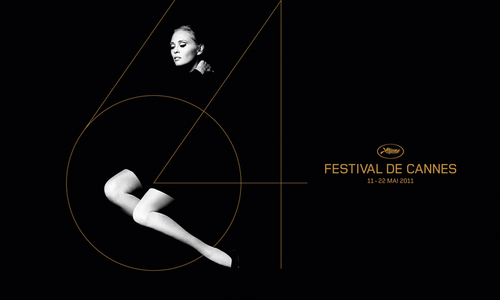
As I approached the Festival Palais early this morning, a light breeze wafted down the fabric of the immense billboard-size banner of this year’s festival poster over the facade. The glamorous photo of a leggy Faye Dunaway, by director Jerry Schatzberg from his 1970 film “Puzzle of a Downfall Child,” was rippling and creasing in a way that made the sleek legs appear to be covered by a pair of ill-fitting tights. Little did I suspect that Faye’s wardrobe malfunction was a bad omen for a seemingly promising day on which three out of the only four films by women selected for this year’s Cannes competition were scheduled to screen.
British actress Tilda Swinton, who gravitates to daring roles, plays Eva, a conflicted New York mother “We Need to Talk About Kevin” by Scottish director Lynne Ramsay, based on the novel by Lionel Shriver. Eva’s son Kevin is portrayed as having a deep animosity toward his mother, virtually from the moment of his birth. As an infant, he shrieks hour after hour when alone with her. As he grows, he exhibits a fierce, focused inclination to evil, and that bent will ultimately make him a Columbine-style killer. Kevin might have been a demon child in another kind of movie, but this is not a supernatural story. “We Need to Talk About Kevin,” is a psychological drama centered on Eva’s guilt.
For me, this was a one-note film. Kevin is thoroughly bad; Eva is thoroughly angry, self-hating and stoic. I longed for some shades of subtlety, but this is a story that relies on blood-red coding in dreams and flashbacks, and a soundtrack that emphasizes grating irritants. Ramsay, who acquitted herself very well with films including “Ratcatcher” and “Movern Callar,” seems an ill match for an American setting, letting raucous bluegrass numbers and stereotyped characterizations of Eva’s small town neighbors and co-workers stand in for insight.
Great directors and their stampeding fans
My first movie at Cannes will hopefully end up being my worst movie at Cannes. I chose to see “William Vincent,” directed by Jay Anaia. James Franco starred and produced, as it was his production company Rabbit Bandini Productions that made the film.
I love James Franco and think he is a great actor. I was interested in finding out the types of films he would make if given more control. Unfortunately, the result was disappointing.
Coming down from those 6-hour dinners…
May 22 — The past three days have been a whirlwind of films, panel discussions and French-style dining (meaning 6-hour dinners that start at 8 pm at the earliest). All of this has resulted in minimal sleep or in some extreme cases, no sleep at all. On Wednesday, after a solid week into the festival and with less than a week to go, the atmosphere becomes more restless than usual. People can feel the end approaching and a repressed feeling of panic can emerge.
Full screenings and empty stomachs
May16 — The temperature finally felt like it had risen today. I broke a sweat as I made my way to the Olympia theater to see “The Bang Bang Club,” directed by Steven Silver. The film is based on the novel titled “The Bang-Bang Club: Snapshots from a Hidden War,” written by Greg Marinovich and Joao Silva. The book and film are about photojournalists and their intense struggles to capture the violence that was taking place within the various townships of South Africa during apartheid.
Chinese Documentaries: an Inside Look
• Grace Wang of TorontoChinese documentary films are important because they reflect, from the closest distance possible, in the most direct way possible, the rapid social, political, and cultural changes happening in China right now.
A Market Badge of one’s own
T minus one paper to Cannes…
I have one more paper to write before I was going to allow myself to focus on my trip to the Cannes Film Festival. But I am failing miserably at this task and have been for the past couple of months.
Ever since I saw Hitchcock’s “To Catch a Thief” at Robert Osborne’s Classic Film Festival here in Athens, Ga., my mind has been on one thing and one thing only — Cannes, Cannes, Cannes and all the wonderful luxuries that come with it.
Watching Cary Grant and Grace Kelly walk around the Carlton Hotel and drive along the hillsides of Monaco would make anyone envious of the beautiful Mediterranean scenery.
Once the official line-up was released I couldn’t help but indulge myself. At first glance I immediately noticed Jean-Luc Godard’s “Film Socialisme,” which is in the Un Certain Regard category.
Ten films, four days, relentless Hong Kong
• Grace Wang of TorontoIt’s my last day in Hong Kong and I’m spending it indoors – specifically – at a Starbucks in Kowloon Station across from the cross-border bus terminal, of which I’m booked to get on a bus in 3 hours back to Mainland China.
Across from me in the cushy tan sofa, a woman is dozing over an English newspaper. The headlines reads “EU summit puts off the tough decisions”… Hmm, not exactly light Sunday afternoon readings (or is it Saturday? I lose count). She has long curly dark brown hair that is half-dry and is dressed fashionably in jeans and a black leather jacket. She looked a little anxious when asking whether the seat was taken, and a little taken aback when I blurted out “no” in English (caffeine hasn’t quite sank in then yet). Is the newspaper part of an effort to brush up on her English? I wonder. Did she have a rough night? Is she waiting for someone?
Beijing. Home.
First of a series as our Far-Flung Correspondent returns to her birthplace – RE• Grace Wang of Toronto
I’ve always thought about coming home.
As a person of Chinese descent, I was born and raised on this yellow earth until my early teens. It was my home, my roots, my place.
Then, one day, that place shifted… across the ocean to another continent, to a place called Canada, and along I went. In a strange country where everything was bewilderingly new, where even the light seemed different (less pollution, probably), I had to learn to be who I was all over again. I loved books, and suddenly I couldn’t read. I loved writing, and suddenly I couldn’t write. Well, not in a way that was understood to be the norm anyway. To a kid, there was no more important thing in the whole, wide world.
“The Tree of Life” takes the Palme d’Or
The Closing Ceremony of the 64th Cannes International Film Festival took place today in the Grand Theatre Lumiere in the Festival Palais at 7:15 pm French time.
Since I had already left the festival on Friday, I was watching online as Jane Fonda slithered up to the microphone to present the Palme d’Or, looking like a
The bookie for the Palme d’Or
May 22, 2009–Austrian Michael Haneke’s “The White Ribbon” is shot in black-and-white and set in an Austrian village in the two years leading up to the outbreak of World War I. A series of increasingly disturbing happenings over a period of months disrupts the otherwise uneventful flow of isolated rural life. These include a planned accident that nearly kills the village doctor, the torture of a child by unknown assailants, and the burning of a barn.
At first it could be assumed that this is a mystery and that Haneke’s intention is to gradually reveal the perpetrators of the increasingly bizarre and cruel acts. Instead he seems to be moving into Dreyer territory, unfolding the story of repression and escalating evil in beautifully precise but rigid compositions that echo the sternness of the social mores and moral precepts of his characters.
Large families headed by unbending fathers are at the center of this film, and there are many children. The actions of certain children arouse suspicion, but then nearly everyone in the film arouses suspicion, as this is no ordinary mystery. In the end, the disturbing chronicle circles around to the beginning to find a meaning. The film’s narrator began the story by saying that the events he was about to unfold may shed some light on later happenings. Haneke leaves it to his audience to decide what is meant by this, but it isn’t too much of a stretch of the imagination to think that these are the youngsters who grew up to wear brown shirts and swastikas.
Apocalypse von Trier; Miike in 3-D
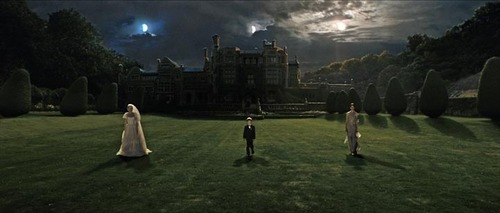
Another much-anticipated film by one of the big names in this year’s Cannes competition premiered this morning — “Melancholia” by Lars von Trier. It’s no secret that this apocalyptic science fiction drama ends with the destruction of the earth, since that is revealed in the first few minutes of the film. The character played by Charlotte Gainsbourg, neatly summarizes von Trier’s dark pessimism with the line, “The earth is evil; we don’t need to mourn for it.” What is rather amazing is that a film about the destruction of all life (and von Trier posits that we are alone in the universe) could be so turgid.
That said, I think I rather prefer von Trier’s wacko view of the cosmos in “Melancholia” to Terrence Malick’s in “The Tree of Life.” With the ingredients von Trier had to work with, it’s surprising that he didn’t make a better film. Following the various forms of desecration and transgression that are the hallmarks of “Antichrist,” it’s as if he felt the need to top himself with an even more outrageous concept, but forgot to figure out what the outrageous part would be.
“Melancholia” examines the relationship of two sisters, Justine (Kirsten Dunst) and Claire (Charlotte Gainsbourg) in the final days before the planet named Melancholia is due to collide with the earth. The story falls into two parts. The first is named for Justine, who is blonde, conventionally pretty, and mentally unstable. The second is named for Claire, who is Justine’s opposite in every way, not only in her lean, dark-haired appearance, but in her down-to-earth competence in managing the stuff of life.
Cannes 2011: All eyes forward
As the opening night of the Cannes International Film Festival approaches, a host of Riviera amenities and services hope to lure my business via solicitous e-mails. Would Madame perhaps like to hire a helicopter for the journey from the Nice airport to the Festival Palais? Rent a limousine with a multilingual driver? Charter a yacht or rent a fully staffed villa with swimming pool (photos handily attached)?
Me, I’m just in the market to rent a no-frills mobile phone with a European SIM card, and I’ll be taking an inter-city bus from the airport, but you get the picture. The sparkling goodies of this playground of millionaires are dangled before the thousands of accredited journalists, theater programmers, film buyers, and filmmakers soon to be heading for the legendary festival. Most of us will be pinching the Euros until they scream, but nonetheless enjoying the nonstop spectacle provided by those who get to ride around in helicopters.
The festival opens the night of Wednesday, May 11 with Woody Allen’s “Midnight in Paris.” “Monsieur Woodee,” as the French are wont to call him, made his first visit ever to Cannes in 2002, when his “Hollywood Endings” opened the festival. Although the film was disappointingly lackluster, it certainly made no difference to his French fans, who hailed him like an emperor. I watched Allen on that occasion from a seat among the hyper-excited audience, marveling at his frail stature, almost inaudible voice, and the shrinking body language that made him seem an incongruous god of cinema.
