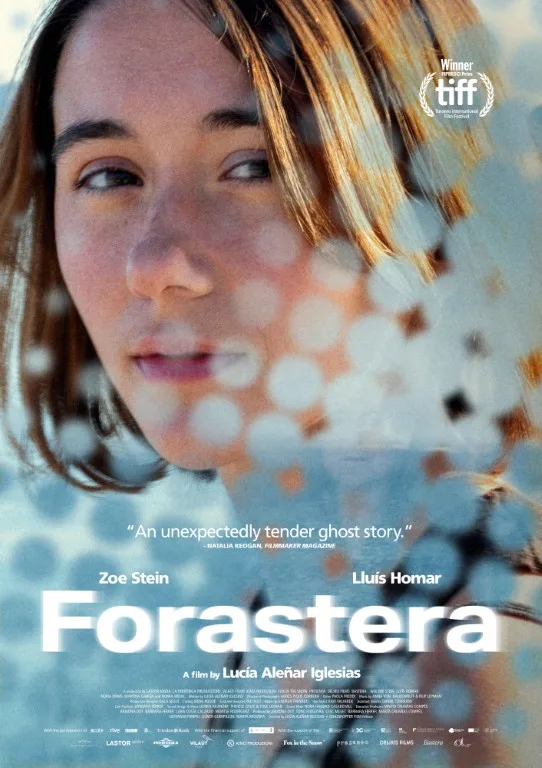


Sharp teenager Catalina (Zoe Stein) has a knack for making things up, from her innocuous assertion that she saw a dolphin while kayaking to more serious falsehoods that she slowly begins to believe are true. So when she has an opportunity to inhabit another person’s life more literally, she seems to relish the opportunity in Spanish writer-director Lucía Aleñar Iglesias’ “Forastera,” expanded from her 2020 short film of the same name.
But Cata’s attempt at usurping someone else’s history is not as simple as a juvenile performance or playing dress up; her transformation could, in fact, be a spiritual haunting. The process of quiet transmutation in cumulative gestures is an entrancing, at times unnerving proposition with gestures to the ghosts of Olivier Assayas’ “Personal Shopper” or reincarnation in Jonathan Glazer’s “Birth.”
Cata and her younger sister, Eva (Martina Garcia), are spending the summer in Mallorca with their Catalan-speaking grandparents. Their house by the water offers breathtaking vistas from their airy, spacious rooms. It’s an idyllic life. But when her adoring grandmother, also named Catalina (Marta Angelat), dies in a tragic home accident, Cata seeks to soothe the agony that consumes her despondent grandfather Tomeu (Lluís Homar). It starts with wearing her grandmother’s dresses from her youth. The first time Tomeu sees her in one of those garments, we see it as a stunning, ethereal vision, thanks to cinematographer Agnès Piqué’s use of light within the home.
Sunlight looms large, washing over people and places for dramatic effect, especially in a sequence near the end that suggests a supernatural visit. Or maybe it’s nothing more than light? Aleñar Iglesias’s ambiguity on the matter is quite intoxicating. Even so, Filip Leyman and Anna Von Hausswolff’s tense, melancholic score soars through intimate moments that could easily have been silent but are instead permeated by an unexpected grandeur, making “Forastera” feel like a larger, more intense picture than the exquisite imagery alone could.
Cata’s mother, Pepa (Núria Prims), voices her unease at her daughter wearing her late mother’s clothes, but only Tomeu realizes how the girl has slowly appropriated some of his wife’s attitudes and specific quirks. And while he doesn’t cross the line into more perverse territory, the elderly man does find solace in Cata becoming a sort of surrogate partner. Some of the life-altering anecdotes she’s heard about her grandmother appear to recur in the present for Cata with uncanny similarity, further inviting the otherworldly as a possible answer to the mysterious occurrences.
The title, which translates to “foreigner,” goes beyond Cata’s status as a city girl visiting the coast; it reads as if her mimicry were a siege or an occupation. That interpretation would still apply if her grandmother’s specter had indeed come from the hereafter to possess her youthful body. In that case, Catalina Sr. would be a “forastera” in the land of the living. That we get no definitive evidence of either is part of what makes Aleñar Iglesias’ writing and execution so gripping.
As Cata submerges herself more deeply into her grandmother’s persona, Aleñar Iglesias draws gasp-worthy interactions that cast an even stronger shadow of suspicion over the truth. A sly smile crosses Stein’s face when Cata realizes a small physical detail she had faked to resemble the deceased woman might actually be a permanent part of her body. This may seem like a silly comparison, but it calls to mind that scene in “The Little Mermaid” where Ursula, in the body of a dark-haired woman named Vanessa, looks at herself in the mirror, pleased with how effectively she has deceived everyone around her.
The trick the film successfully pulls (making one question who is truly inhabiting that body) hinges on Stein’s precise physicality and the tiniest of choices in how she interacts with the other performers (like when she starts casually referring to her grandfather by his first name). Her expertly controlled performance sells the ambiguity. There are enough elements planted early to suggest Cata is just acting, but also clues that point to something else, including how the adults around her react to her “portrayal.”
Tight and taut, “Forastera” is a major discovery, handling grief with alluring stylistic choices that enhance the already remarkable narrative. If ghosts exist, Aleñar Iglesias has learned the cinematic sorcery to house them. It’s a luminous, spellbinding movie.