Star Trek Into Darkness
Less a classic "Star Trek" adventure than a Star Trek-flavored action flick, shot in the frenzied, handheld, cut-cut-cut style that’s become Hollywood’s norm, director J.J.…
Families create their own narratives. Stories are passed on from generation to generation, and in this way the past continues to live, but it can…
"The Ballad of Narayama" is a Japanese film of great beauty and elegant artifice, telling a story of startling cruelty. What a space it opens…
Patrice Leconte's "Monsieur Hire" is a tragedy about loneliness and erotomania, told about two solitary people who have nothing else in common. It involves a…
At Cannes, the Coen brothers discuss their inspirations for "Inside Llewyn Davis."
Billy Wilder's under-appreciated 1978 "Fedora" returns to Cannes to remind us that some things, like the fear of aging among celebrities, never change.
Roger was a titan in the film community, but he was also a beacon for the seriously disabled.
Mother’s Day I awakened to spirited calls from my children and grandchildren. As Roger wrote in his memoir, “Life Itself,” I came from a large family of nine, and I had four brothers and four…
Roger was a titan in the film community, but he was also a beacon for the seriously disabled.
Ray Harryhausen told us, time and again, the story of how he saw the original "King Kong" (1933) on the big screen when he was…
Dear Roger,You emailed me the questions to this interview on March 15, 2013. In your March 16th reply to my email, you said: The piece…
Tilda Swinton leads 1,500 people in a dance-along to Barry White's "You're the First, the Last, My Everything" during Roger Ebert's Film Festival in the…
Named after the David Cronenberg film, this is the blog of RogerEbert.com founding editor Jim Emerson, where he has chronicled his enthusiasms and indulged his whims since 2005. Favorite subjects include evidence-based movie criticism, cinematic form and style, comedy, logical reasoning, language, journalism, technology, epistemology and fun. No topic is off-limits, but critical thinking is required.
![]()
![]()
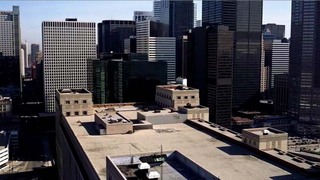
The corporate logos are deep blue and black: Warner Bros., Legendary Pictures, DC Comics. Then, out of a silent explosion of blue flames and black smoke, the familiar Batman shadow appears. Cut to bright afternoon daylight. The camera glides with surreal smoothness above a recognizably real American cityscape, over the rooftop of a large, squat building toward a cluster of shiny glass skyscrapers. This is not the forbidding, neo-Gothic Gotham City we expect to encounter at the beginning of a Batman movie, a densely stylized urban forest of inky comic-book noir. It's almost like Phoenix at the start of Alfred Hitchcock's "Psycho" (1960): Anywhere, USA.
![]()
And that may well be the idea: The camera closes in on a colossal mirror, a wall of tinted windows in the side of a building. What are we looking for? How much closer can we get before something has to happen? (Where's the helicopter? You'll catch a glimpse of it at the far left, just at the moment your eye is distracted by an exploding window near center frame.) For a fraction of a second we may wonder about the fate of the people inside the room, and the pedestrians on the street below who are about to be showered with bits of glass. But before that can quite register we're on the other side of the blown out window with a pair of clown-masked gunmen. This is part of some diabolical plan... which turns out to be a bank robbery in progress. (See other notes on this shot, and the rest of this sequence, here.) Turns out, the building we've just passed over is the most important element in the shot; the glass wall is just a means to an end. Smoke and mirrors...
![]()
![]()
I had no idea where "The Dark Knight" was going to take me from here, but I had a smile on my face by the end of the first shot, just because of the way it had overturned my expectations of how a Batman movie should begin. (I'd forgotten a similar special-effects shot of Chicago-as-Gotham, following the L along the river to the Wayne Building in the previous movie, 2005's "Batman Begins.")
The movie will play with windows throughout, and with the idea of the city as a perilous stack of window frames -- each one a perch from which you can view some aspect of Gotham, or from which a body might plummet: a Batman lookalike slamming into the mayor's face, with only a pane of glass between them; the Joker shattering a penthouse window and pushing Rachel through it; a line-up of fake Jokers-behind-glass in an unfinished tower...
![]()
The camera chopper.
![]()
View of Gotham in "Batman Begins" (2005).
Next Article: Opening Shots: Shotgun Stories Previous Article: Opening Shots: Spider-Man 2
At Cannes, the Coen brothers discuss their inspirations for "Inside Llewyn Davis."
Roger was a titan in the film community, but he was also a beacon for the seriously disabled.
Billy Wilder's under-appreciated 1978 "Fedora" returns to Cannes to remind us that some things, like the fear of agin...
While Cannes's red-carpet crowd toasts the Coen brothers' tuneful "Inside Llewyn Davis," the parallel programs have a...