
 Great Movies


From Kris Pigna:
"Spider-Man 2" begins with an extreme close-up of a woman's face, a dissolve from the last image of the opening credits. Against a stark white backdrop, she stares right into the camera, deeply, with the kind of eyes that are easy to fall in love with. "She looks at me every day," Peter Parker says in voiceover. "Mary Jane Watson. Oh boy. If she only knew how I felt about her." The camera slowly pulls out on this ideal, dreamlike image.
"But she can never know. I made a choice once to live a life of responsibility, a life she can never be a part of." The camera pulls out far enough to reveal we're actually looking at a billboard, a perfume advertisement Mary Jane posed for. "Who am I? I'm Spider-Man, given a job to do. And I'm Peter Parker, and I too have a job." The camera pulls out farther, and we see Peter come into frame on his pizza-delivery moped, gazing at the billboard over his shoulder with full attention. Suddenly we hear a man calling his name, and Peter's attention is snapped. So is the dream.

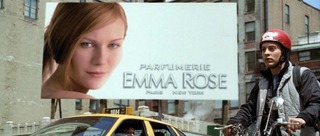
The beginning of the shot shows us exactly how Peter sees Mary Jane -- all he wants in the world. By the end of the shot, we see Peter's reality, and what's keeping him from being with her. That's Peter's dilemma -- and the movie -- in a nutshell: a struggle between his desire to lead a normal life with the girl he loves, and his belief in using his powers responsibly to do some good. Yes, this is a glorious entertainment, but "Spider-Man 2" stays true to the roots of the character -- the most human of all classic superheroes -- by simultaneously being one of the most intimate and humanistic summer blockbusters ever made. The movie doesn't open with a bang, but with a moment of quiet reflection and deep longing, and it sets the tone for Peter's struggle (and the film) to come.
The opening shot is perfectly balanced with the last shot, where we get one last look at Mary Jane's face (in the flesh) as she watches Peter web-sling away from his apartment window. By now Peter and Mary Jane have agreed to be together despite the dangers his crime fighting may pose to her, and yet... the same idealism isn't quite there. Director Sam Raimi made a daring choice to end his big, crowd-pleasing action flick on an oddly ambiguous note, as the expression on Mary Jane's face turns to a look of concern... or perhaps of doubt. Did she make the right choice? Will maintaining a relationship with a superhero be too hard? Is she just worried about Peter's safety? She wonders, and so does the audience.
Sadly, the power of this last shot has been lessened now that we know the absolute horror that comes after it. But it helps to pretend "Spider-Man 3" was never made, which is, I propose, a prudent thing to do in general.
JE: Thanks, Kris. I hadn't thought about how the film is bookended with shots of Mary Jane -- the first idealized (both mass-merchandized and through the eyes of Peter) and the last in a moment that reveals her inner doubts.
As you say, Peter/Spider-Man's dilemma is "a struggle between his desire to lead a normal life with the girl he loves, and his belief in using his powers responsibly to do some good." That puts him in good superhero company and, it occurs to me, also describes the "Last Temptation" of Nikos Kazantzakis's and Martin Scorsese's Jesus Christ. Perhaps "Spider-Man 3" can be thought of similarly, as a momentary hallucination...


