
 Great Movies

 ">
">
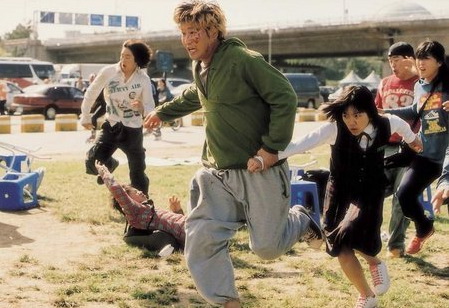
"Run away! Run away!"
From my review of "The Host" on RogerEbert.com:
Continued at RogerEbert.com...A horror thriller, a political satire, a dysfunctional family comedy, and a touching melodrama, Bong Joon-ho's "The Host" (2007) is also one helluva monster movie. It's the recombinant offspring of all those science-fiction pictures of the 1950s and '60s in which exposure to atomic radiation (often referred to as both "atomic" and "radiation") or hazardous chemicals (sometimes also radioactive) results in something very large and inhospitable: "Them!" (giant ants), "Tarantula" (giant spider), "Matango: Attack of the Mushroom People" (giant fungi), "The Amazing Colossal Man" (giant bald guy), "The Giant Behemoth" (giant behemoth -- both giant and a behemoth, but more precisely a radioactive ocean-dwelling Godzilla clone), "Frankenstein Conquers the World" (giant Frankenstein's monster atomically regenerated from the beating heart of the original monster after the A-bomb is dropped on Hiroshima), and so on.
In "The Host" (a k a "Gwoemul"), the mutagen is a simple aldehyde, HCHO (possibly even a radioactive variety). The movie opens in the year 2000 at the Yongsan U.S. Army base in Seoul, where an American mortician (the always superb Scott Wilson, clearly having fun) orders a Korean subordinate to dump dusty bottles of "dirty formaldehyde" into the sink ... which empties into the Han River. When the underling objects, the American insists, "The Han River is very... broad, Mr. Kim. Let's try to be broad-minded about this." Had Al Gore been present, he would have made a persuasive counter-argument with colorful charts and graphs about the dangers of poisoning our fragile planet, but an order is an order, so down the drain the noxious stuff goes.
(This scene is based on a notorious incident involving Albert McFarland, an American civilian mortician at the Yongsan military base, who in 2000 ordered his staff to pour 120 liters of formaldehyde into the morgue's plumbing. Although the chemicals passed through two treatment plants before reaching the Han, source of Seoul's drinking water, the scandal sparked an anti-American uproar in South Korea.)
At the movie's center is the Park family, a clan no less eccentric than the Hoovers of "Little Miss Sunshine." (Think "Little Miss Sashimi.")...
The creature -- just like (spoiler warning) the Moroccan kids who accidentally shoot the American employer of the Mexican nanny with the rifle formerly belonging to the Japanese businessman with the deaf daughter who is sexually provocative in "Babel" (end of spoiler warning) -- unknowingly precipitates an international incident. And in the ensuing pandemonium, the Parks are forced to fend for themselves....


