
Man of Steel
The title "Man of Steel" tells you what you're in for when you buy a ticket to this immense summer blockbuster: a radical break from…
Claustrophobia isn't often considered a cinematic asset beyond tales of suspense and horror. But "Fill the Void," an award-winning Israeli drama about a naive 18-year-old…
"The Ballad of Narayama" is a Japanese film of great beauty and elegant artifice, telling a story of startling cruelty. What a space it opens…
Patrice Leconte's "Monsieur Hire" is a tragedy about loneliness and erotomania, told about two solitary people who have nothing else in common. It involves a…
Before he died, Roger was working on science fiction story about space exploration set in part at his beloved University of Illinois. We're having a…
I cried yesterday at a retreat while listening to Michael Buble's rendition of "Smile." The tears came from out of nowhere. Music has a way…
Before he died, Roger was working on science fiction story about space exploration set in part at his beloved University of Illinois. We're having a…
Asymmetrical journalism and the Rob Ford crack tape; Sofia Coppola's The Bling Ring presents life as "an endless selfie"; James Lipton was once a pimp,…
Kevin B. Lee reports on the film series at MoMA that he co-curated.
Katherine Tulich talks to Julie Delpy, Ethan Hawke and Richard Linklater about returning once again to the characters from "Before Sunrise" and "Before Sunset" for…
You've been told that Superman not a "relatable" character. After all, he's faster than a speeding bullet, more powerful than a locomotive, and all that…
If we said there was a clear throughline from "Bonnie and Clyde" and Richard Donner's "Superman: The Movie," you'd say we were crazy, right? Get…
Named after the David Cronenberg film, this is the blog of RogerEbert.com founding editor Jim Emerson, where he has chronicled his enthusiasms and indulged his whims since 2005. Favorite subjects include evidence-based movie criticism, cinematic form and style, comedy, logical reasoning, language, journalism, technology, epistemology and fun. No topic is off-limits, but critical thinking is required.
In his recent Great Movies review of Michael Haneke's "Caché," Roger Ebert writes of a shot he believes may hold the key to the film's mystery:
How is it possible to watch a thriller intently two times and completely miss a smoking gun that's in full view? Yet I did. Only on my third trip through Michael Haneke's "Cache" did I consciously observe a shot which forced me to redefine the film. I was not alone. I haven't read all of the reviews of the film, but after seeing that shot I looked up a lot of them, and the shot is never referred to. For that matter, no one seems to point to a conclusion that it might suggest....
No, he's not talking about the final shot: "You will find it on the DVD, centering around 20:39," he says. "You tell me what it means. It's the smoking gun, but did it shoot anybody?"
Roger followed up with a blog post about the shot (which you don't want to know about if you haven't already seen the movie) and I offered a couple of comments: here and a follow-up here. Many interesting takes on the film can be found in these comments, which (as I write this) number more than 130. Critic Michael Mirasol, whom Roger quotes, thinks the stationary shot (#2 below, a reverse-angle of the film's opening shot, from Georges and Anne's bedroom, toward the street where the video camera is concealed) is from Pierrot's POV, and provides evidence that links him to the mysterious "Lost Highway"-esque surveillance videos. I don't see it that way, but here are the four shots in question (images from moving shots indicated with arrows):
1.
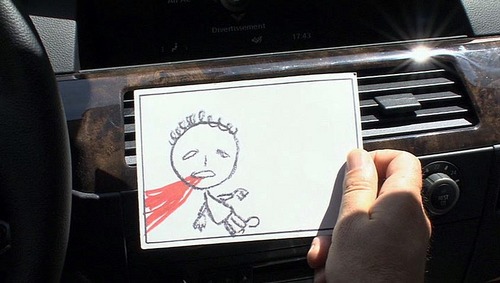
The postcard to Georges that Pierrot gives him in the car.
2.
Long, stationary shot from bedroom window, looking down at the street from which the movie's opening shot (top) was taken. Faint breathing, rustling heard on the soundtrack. This reverse-establishing shot serves as a necessary set-up for the double-shock of the next shot, another reminder not to take for granted what we think we see...3.
Next Article: Hitler on Leno Previous Article: Thank you, James Cameron...
As we mourn Abrams’ macho Star Trek obliteration, it’s a good time to revisit that most Star Trek-ian of accomplishme...
Lateral tracking shots can get to the heart of a film more quickly and succinctly than any other technique. What are ...
I cried yesterday at a retreat while listening to Michael Buble's rendition of "Smile." The tears came from out of no...
Please help me welcome the new Editor-in-chief for Rogerebert.com, Matt Zoller Seitz. What Roger and I found refresh...