Star Trek Into Darkness
Less a classic "Star Trek" adventure than a Star Trek-flavored action flick, shot in the frenzied, handheld, cut-cut-cut style that’s become Hollywood’s norm, director J.J.…
Families create their own narratives. Stories are passed on from generation to generation, and in this way the past continues to live, but it can…
"The Ballad of Narayama" is a Japanese film of great beauty and elegant artifice, telling a story of startling cruelty. What a space it opens…
Patrice Leconte's "Monsieur Hire" is a tragedy about loneliness and erotomania, told about two solitary people who have nothing else in common. It involves a…
If you go to a yacht party, don't expect to be living out your own version of "The Talented Mr. Ripley."
When Chaz has gone to Cannes without Roger in the past, she has written about the festival n the form of letters and postcards to…
Roger was a titan in the film community, but he was also a beacon for the seriously disabled.
Mother’s Day I awakened to spirited calls from my children and grandchildren. As Roger wrote in his memoir, “Life Itself,” I came from a large family of nine, and I had four brothers and four…
Roger was a titan in the film community, but he was also a beacon for the seriously disabled.
Ray Harryhausen told us, time and again, the story of how he saw the original "King Kong" (1933) on the big screen when he was…
Dear Roger,You emailed me the questions to this interview on March 15, 2013. In your March 16th reply to my email, you said: The piece…
Tilda Swinton leads 1,500 people in a dance-along to Barry White's "You're the First, the Last, My Everything" during Roger Ebert's Film Festival in the…
Named after the David Cronenberg film, this is the blog of RogerEbert.com founding editor Jim Emerson, where he has chronicled his enthusiasms and indulged his whims since 2005. Favorite subjects include evidence-based movie criticism, cinematic form and style, comedy, logical reasoning, language, journalism, technology, epistemology and fun. No topic is off-limits, but critical thinking is required.
![]()
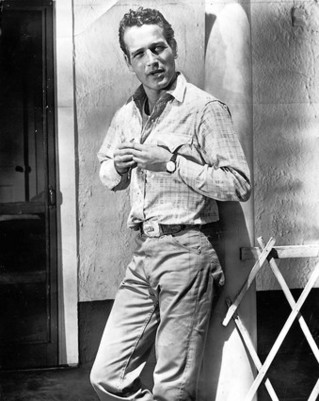
Clips from the on-screen life of the late Paul Newman, actor and movie star:
Richard T. Jameson at MSN Movies:
Paul Newman's entrance in "Hud" (1963) is actually an exit, emerging just past dawn from a nondescript house on the side street of a no-name Texas town that barely has one street to begin with. He's the title character, of course, mid-30s, the lone surviving son of a local rancher, and he's been spending the wee hours with a married woman whose husband is about two minutes away from arriving home. Hud's nephew Lon (Brandon de Wilde) has been looking for him, found his big pink Cadillac brazenly parked in front of the house, and called him out.
So here comes Hud, snarling, tearing himself away from business left unfinished offscreen and lunging onto the small front porch. The shot is pretty straightforward but Hud's an insouciant angle: his body canted so that one side of him is advancing before the other, his spine still in the reluctant process of drawing itself erect, his left arm lifted in anticipation of leaning on the porch post between him and the camera. "This had better be good," he growls, into the lean now and letting his torso sag a little -- signaling that he's in charge here, but also allowing for the possibility, indeed the expectation, that maybe he can get out of whatever this is without raising a hand.
![]()
Sheila O'Malley at The House Next Door, on Newman's role as the Stage Manager in the 2003 television production of Thornton Wilder's "Our Town":
"Do any human beings ever realize life while they live it?--every, every minute?"
Roger Ebert on "Cool Hand Luke" in 1967:
Now in his latest film, "Cool Hand Luke" [following ("The Hustler," "Hud," "Harper" and "Hombre"], Newman brings this character to the end of its logical development, playing a hero who becomes an anti-hero because he despises the slobs who worship him. Luke is on a Southern chain gang. He's the only prisoner with guts enough to talk back to the bosses and the only one with nerve enough to escape. [...]
Used to be the anti-hero was a bad guy we secretly liked. Then, with Brando, we got a bad guy we didn't like. An now, in "Cool Hand Luke," we get a good guy who becomes a bad guy because he doesn't like us.
Luke is the first Newman character to understand himself well enough to tell us to shove off. He's through risking his neck to make us happy. With this film, Newman completes a cycle of five films over six years, and together they have something to say about the current status of heroism.
Next Article: Be offended. Be very offended. Previous Article: Why movie critics make such darn good political pundits
Marie writes: Now this is really neat. It made TIME's top 25 best blogs for 2012 and with good reason. Behold arti...
If you go to a yacht party, don't expect to be living out your own version of "The Talented Mr. Ripley."
When Chaz has gone to Cannes without Roger in the past, she has written about the festival n the form of letters and ...
James Toback discusses his new documentary, "Seduced and Abandoned," which traces the life of a failed movie project....