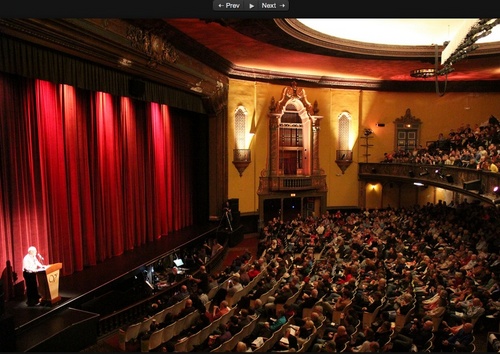
In a back row of the Virginia Theater in Urbana-Champaign, Illinois, you will see a raised platform just the right size to hold a reclining chair. This is my throne at Ebertfest. Because of havoc wrought by surgery to my back and right shoulder, I cannot sit comfortably in an ordinary chair. Here I recline at the side of my bride, looking upon the packed houses.
I realized something this year that has been true before. Ebertfest draws perfect audiences. During a film that requires total silence, like “Take Shelter,” the audience was totally absorbed. During a comedy, like “Joe versus the Volcano,” they laughed easily at the right places. They got wound up during “Kinyarwanda” and “Big Fan,” and were deeply moved by “A Separation.” They were in sympathy with “Terri.” They opened their hearts to the beautiful Indian family drama “Patang.” They negotiated the deep moral waters of “Higher Ground.” They felt joy and sympathy with our guest of honor, the Australian director Paul Cox, who has survived a liver transplant. There were countless intelligent questions, in Q&A sessions that lasted 45 minutes. There were no clueless fan questions,
They were always in tune.
A friend who was sitting in the front row of the balcony, looking down on the ground floor, told me there was not one single little block of light betraying a cell phone. Most amazing of all was the audience’s reception of the final film, which was “Citizen Kane.” We played my audio commentary track during the screening, so my voice could be heard one last time in the Virginia. Listening to a film critic talk all the way through a movie would inspire restlessness, even rebellion, from some audiences. Miraculously, once again, everyone was attentive. They actually cared about what I was saying. (Apart from one woman I heard in the lobby loudly demanding her money back because she paid to see a movie and somebody talked all through it.)
Some of our guests, directors and actors, mentioned this. Not only had they never before seen their film on such a large screen before such a large audience, but they hadn’t shared it with an audience like that–1,500 people. Today’s audiences are often noisy and disrespectful, considering themselves part of the show. They complain to theaters that they aren’t allowed to text during movies.
Can you really blame them? How many of today’s films really hold your attention? When you see a film that does, it’s a reminder of how most movies used to work. A new film like “The Avengers” is a perfectly competent piece of work, delivering what the audience expects. It is also an assembly of absurd comic book caricatures with no human aspects, embedded not in a story but in a series of brief sensational moments of special effects action.
My friend Richard Corliss of Time magazine does a masterful job of exercising faint praise. He writes: “The movie guarantees fast-paced fun without forcing anyone to think about what it all means, which is nothing. ‘A poem should not mean / but be,’ Archibald MacLeish wrote. A pop-culture smash should not mean but do: break stuff, agitate the senses, keep the customer satisfied. The Avengers doesn’t aim for transcendence, only for the juggler’s skill of keeping the balls smoothly airborne, and in 3-D too (converted after production). At that it succeeds.”
At that it succeeds. If that’s what you want. I said sort of the same thing. It is not high praise. I have a feeling the audiences at Ebertfest would have been as restless and unruly during “The Avengers” as a crowd of fanboys at a Bergman. Who are the people in an Ebertfest audience? Some came from out of state, and others from all over Illinois. Many are locals, and University of Illinois students. There are always about 50 older people, block-booked by Road Scholars. As I thought about them, it occurred to me that they were the right age to have been members of the Film Generation in the early 1960s. They were lining up for Godard in their 20s, and now Road Scholars sells them a package tour to Ebertfest. God love them. Nobody signs up for nonstop movies from Wednesday night until Sunday afternoon without knowing why they go to the movies.
We had about 15 audience members who write for my website. These were the Far-Flung Correspondents and the Demanders (who do On Demand films). They were from Egypt, India, Poland, Brazil, Mexico, Canada, the UK–from all over. One of them wrote me, “Thank you for reminding me what a moviegoing experience can and should be. This is why I got into film criticism.”
The great fim scholar David Bordwell, in introducing the Alloy Orchestra’s program of silent films, said a few words about movie palaces like the Virginia, built in the 1920s. They ennobled and enshrined motion pictures. It seems to me that today’s multiplexes slice movies into franchises like a mall with so many strip stores.
But as I sat on my throne in the Virginia Theater and joined a perfect audience, knowledgeable and attentive, watching good movies, I thought…
Don’t let it be forgot
That once there was a spot
For one brief shining moment that was known
As Camelot.
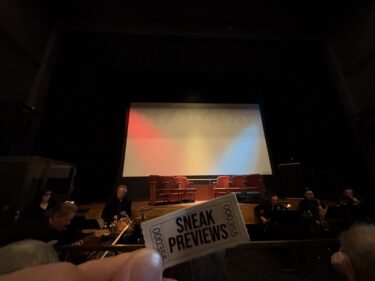
The photo at top is by Pablo Villaça, my Far-Flung Correspondent from Brazil. It shows David Bordwell introducing a program of silent films that will be accompanied by the Alloy Orchestra, which can be seen in the pit.