
 Great Movies


For the first time in a long time, she has breakfast with her husband. But now, nobody in her house will talk to her. She is Arati, wife of Subrata, and to help pay expenses she starts her first job outside of the home. In Satyajit Ray's tender "Mahanagar" (1963) aka: "Big City," we follow a quiet Indian family's struggles against the nearing claws of modernity.
Graphics selection and page design by Marie Haws
It is the middle of the twentieth century. The Indians are newly liberated from the British, and now wrestle with the intense transformations demanded by mass production, international trade, fluctuating economies, and subsequent urbanization. The new noisy metropolitan world wreaks trauma on the sacred, stateliness dignity of the home. In this process, we follow the travails of the Mazumdar family, living tightly packed in an apartment. Subrata, a banker, struggles to provide for his wife, son, sister, mother and father but in this role, he finds his sense of worth. Arati struggles to maintain her decorum against the various stresses at home, has thoughts of the world outside, but smiles as she cares for those she cares for.


She gets a job selling sewing machines in Calcutta, even though she is initially frightened by the big city, frightened by her boss, and frightened by her clients. Simultaneously, as his bank abruptly closes, he loses his job and loses his self worth. Meanwhile, his cranky father, unsettled by his own aging and consequent wounded pride, gives up on get-rich-quick schemes, disowns his son, ridicules his daughter-in-law, and sets out in the big city to find others - former students - to care for him. As the story unfolds, we get the sense of increasing feelings of a world closing in on them, leaving them feeling helplessness and worthlessness in the face of these changes.
Their apartment is so small that their conversations are given soundtrack from the music and conversations of their neighbors. The natural assumption is that the neighbors might likewise listen to them. So, their at-home conversations are already hushed to maintain dignified privacy from each other, but reach the point of whispers to keep the neighbors out. The result for us is a very deeply intimate movie. The film is so quiet, yet the sentiments are so vivid and so deep.

Further, the Western cultural encroachment plays out differently for each of the main characters. Subrata often carries himself in a western posture, especially with his cigarettes. His wardrobe is partly western and partly Indian; often he dresses in western blazers (incidentally imported culturally from the Turks to the Europeans to the Indians) with Indian Shalvar and Kameez. As Arati works in her sari, she is exposed to lipstick and sunglasses. And the seemingly cantankerous father announces that he is in a Cold War against his son.

At the heart of the story, however, is Arati's new job. The first hour of her morning, preparing work, eating breakfast with her husband, is rough. At first, her son complains of sickness and abandonment, but does soften. Her In-Laws ignore her, offended that she is working, and complaining about the burdens her absence will place upon them. It is not so much that they are grouchy; rather, the new cultural onslaught defies their notions of appropriate behavior. There is a short moment where the father waits in a doctor's office and pages through a magazine, quickly getting disgusted by the photos of bikini-clad women.

And, the first days of her job are difficult. Arati and her new colleagues are placed in environments they've never faced. At first, she runs from men and is terrified by her boss. Through the course of the film she gains her confidence and speaks freely with men, speaks freely against her boss, especially when she disagrees with him. He discriminates against an Anglo-Indian in overt ways (demoting her) and covert ways (paying her in crumpled bills, while paying Arati in new, crisp bills), and she lashes at him for his unfairness. But, we also see that she begins to lie to clients also. And, as she exhibits her transformations, Subrata watches from the background, getting troubled not only by her developments, but also by his decreasing sense of usefulness. She correspondingly, is troubled by his changes, yet never demands that he morph for her. There is no question of devotion; the challenge is change.


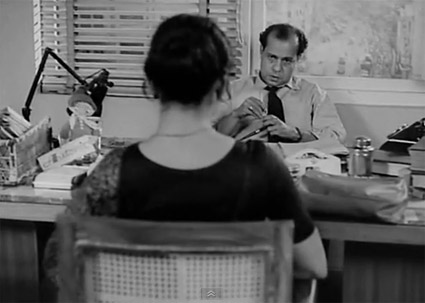

It is easy to watch this movie and see it merely as a feminist - rather, womanist - story of an Indian woman's expanding horizons. In that way, we might categorize it with other movies like Ousmane Sembene's "La Noire De" (commonly known as "Black Girl") or James Ivory's "Howard's End." Or, culturally, we might naturally think of such icons as Rosie the Riveter. And, to great degree, this point would be correct. But, in that process, we might fall into the common Western trap of sympathetic condescension toward the allegedly naïve natives. But, the conversation on gender in "Mahanagar," and to some degree in these other films, takes place in the greater conversations on cultural dynamics responding to changes in the business world.
But, perhaps the most wonderful aspect of this film is that if the viewer misses the role those forces play, it is hard to miss the very tender story of a family struggling to remain together. Further, the joy of watching films by Ray or Ozu or Rohmer is that I never know what will happen next. My Hollywood conditioning expects scandal, and these films certainly do explore scandal. But the scandal is of the variety of human struggle, rather than crime. You will feel the moments of lipstick in this film, perhaps like in no other movie.
It is wonderful that these Satyajit Ray movies are available on DVD, but the prints need to be updated. The translations are satisfactory, but are incomplete, and sometimes too imprecise. Even with those complaints, the deep heart of this film beams through even in low light.

Omer M. Mozaffar teaches at Loyola University Chicago, where he is the Muslim Chaplain, teaching courses in Theology and Literature. He has given thousands of talks on Islam since 9/11. He is also a Hollywood Technical Consultant for productions on matters related to Islam, Arabs, South Asians.


